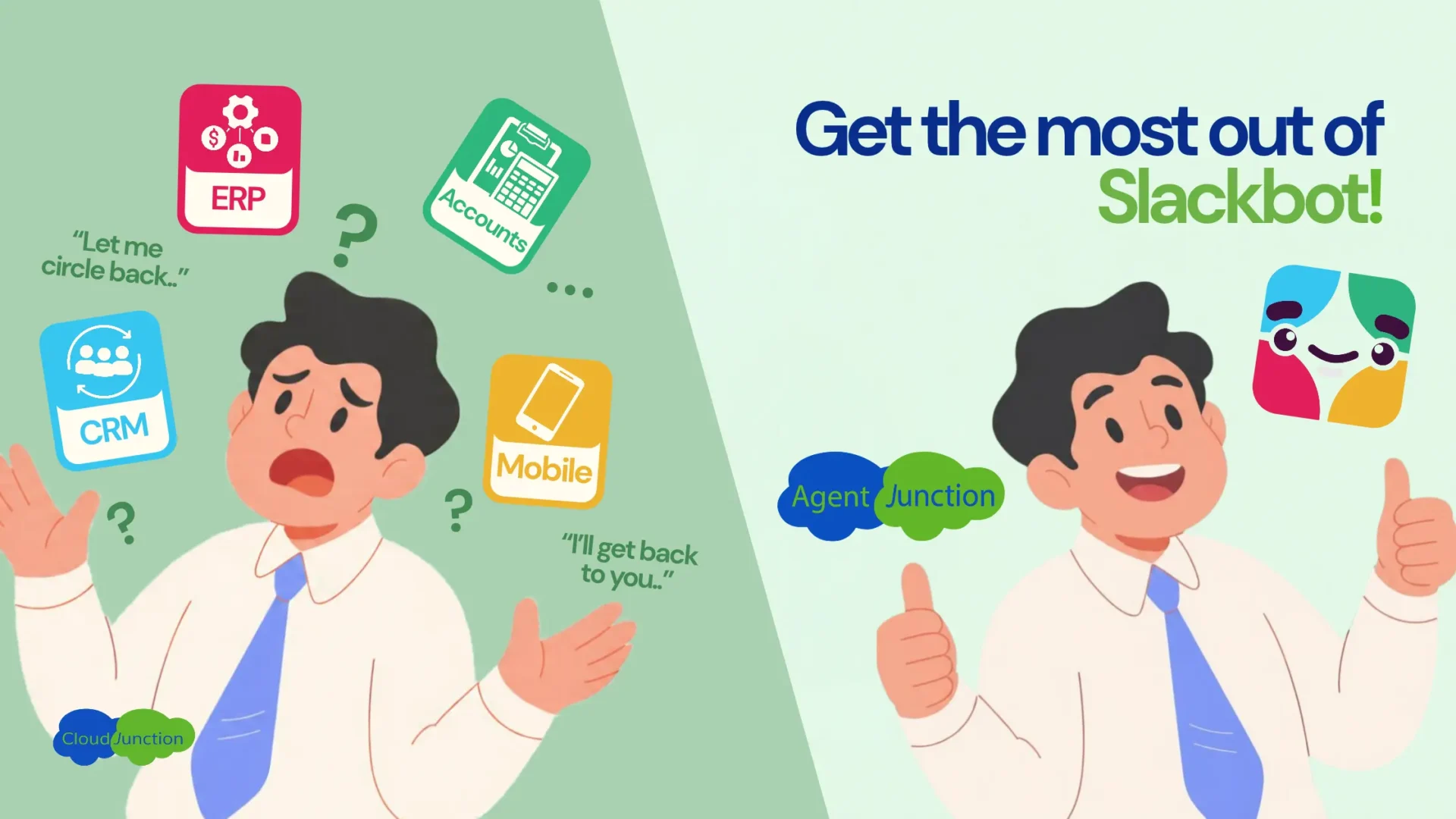
Your field rep is standing in a customer’s facility when the question comes up: “Can you get us 25 of these by next week?” The answer is scattered across the CRM, the inventory system and the accounting app – none of which live in Slack, where your team actually talks all day. So the rep pings the account manager, and the familiar ritual begins: “Let me check and get back to you.”
Slackbot got a lot smarter this year. But out of the box, it doesn’t know what’s in your warehouse or whether that customer is near their credit limit. AgentJunction for Slackbot changes that – and it doesn’t require a new portal, a months-long integration project, or asking anyone to leave Slack.
The Friction: “Let me check and get back to you”
A surprising amount of sales drag happens in the minutes (sometimes hours!) between a customer’s question and a confident answer.
The field rep is stuck waiting on-site
Field reps can’t log into three back-office systems from a phone mid-meeting – nor should they have to. So they wait. Reps already spend 70% of their time on non-selling tasks, according to Salesforce’s State of Sales report. Every ping to the account manager gives the customer a window to call a competitor.
The account manager becomes a “human API”
On the other end of that ping, the account manager opens the CRM, then the inventory system, then accounting, and stitches the answers together by hand. A Harvard Business Review study found that workers toggle between apps nearly 1,200 times a day, losing almost four hours a week just reorienting themselves.
The job title says “account management”. The actual job? Tab-switching.
Half the picture is a risky picture
Checking one system at a time rarely tells the full story. The CRM shows a hot opportunity. Inventory shows 18 units, not 25. Accounting shows an overdue invoice and an account near its credit limit. Promise all 25 based on the CRM alone, and you’ve set up a missed delivery – or an order blocked by Finance the week of the event!
The answer still ends in swivel-chair work
Once the decision is made, someone still has to reserve the stock, update the opportunity and chase the invoice across three different systems – re-typing exactly what was just agreed to in Slack!
Slackbot Got Smarter. Is It Smart Enough (Yet)?
In 2026, Slack reimagined Slackbot from a helpful assistant into a full-fledged AI agent. It now acts as an MCP (Model Context Protocol) client, which means it can connect to external apps, pull live data and trigger workflows right from a conversation – all within each user’s existing permissions.
That’s a huge leap. But an AI agent is only as useful as the systems it can reach. The ERP, inventory and accounting apps that answer “can we ship it – and should we?” rarely come ready to plug into Slackbot. That’s the gap AgentJunction closes for Slack.
Slackbot ERP Integration with AgentJunction: Ask, Understand, Recommend & Act
AgentJunction plugs Slackbot directly to your back-office systems: ERPs, CRMs, inventory and accounting apps, and databases. It doesn’t just read the data – it writes back too, so Slackbot can act on what it finds.
In our demo, field rep Eliza is on-site at Brightside Events, who need 25 light shades for an event next week.
1. Ask – Right where the conversation is already happening
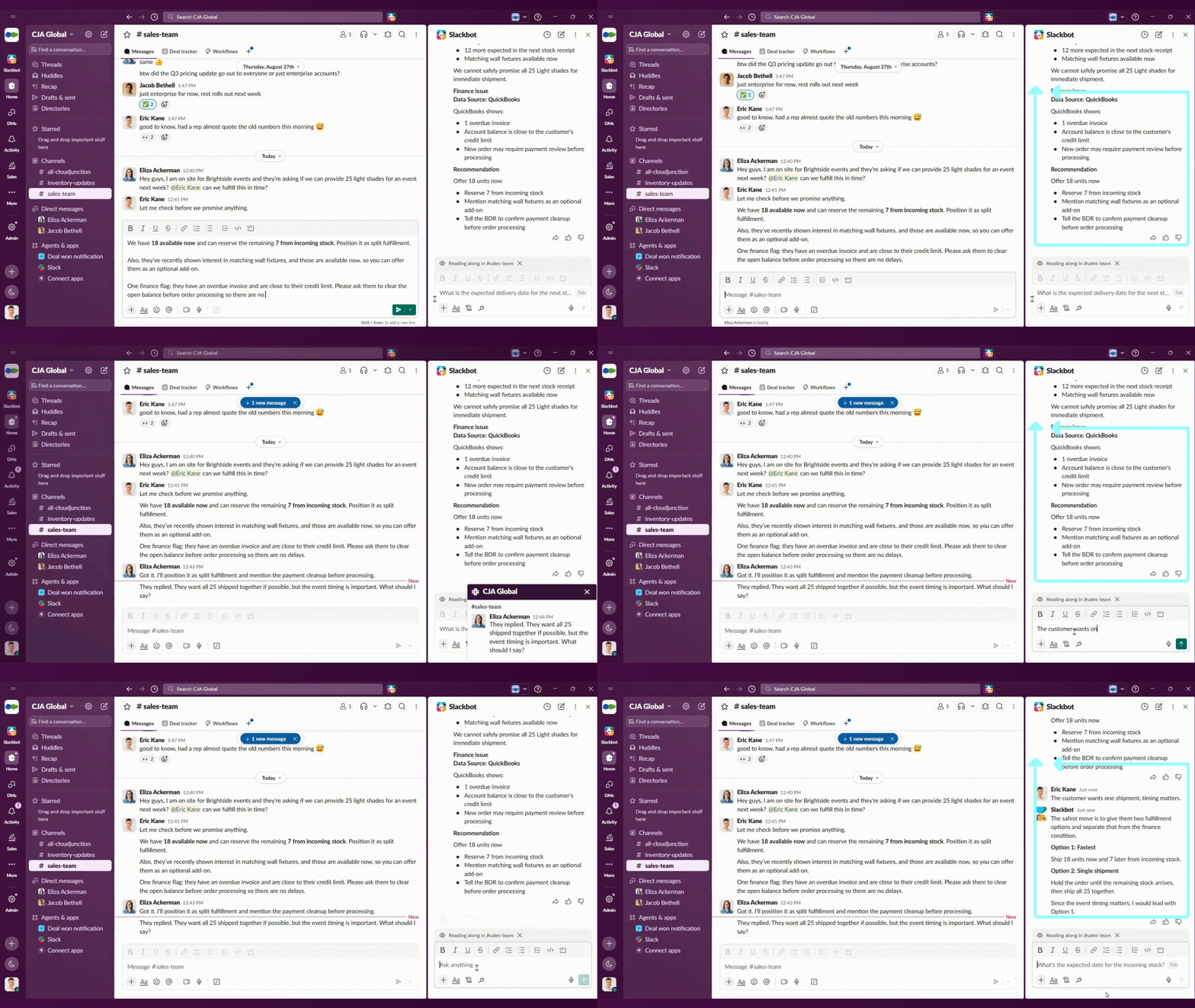
Eliza posts the question in #sales-team. Instead of opening three apps, Eric, her account manager, asks Slackbot in plain English – right beside the channel.
- The old playbook: Log into the CRM. Then the inventory system. Then accounting. Copy, paste, reply… eventually.
- The new playbook: One prompt to Slackbot. One answer, in seconds.
2. Understand – Three systems, one plain-English answer
Behind the scenes, AgentJunction connects Slackbot to Salesforce, Fishbowl and QuickBooks simultaneously, and pulls it all into a single summary:
- Salesforce: An active opportunity for an upcoming venue installation, plus recent interest in matching wall fixtures.
- Fishbowl: 18 light shades in stock now, 12 more on an incoming receipt, and the wall fixtures available.
- QuickBooks: One overdue invoice, and an account balance close to the customer’s credit limit.
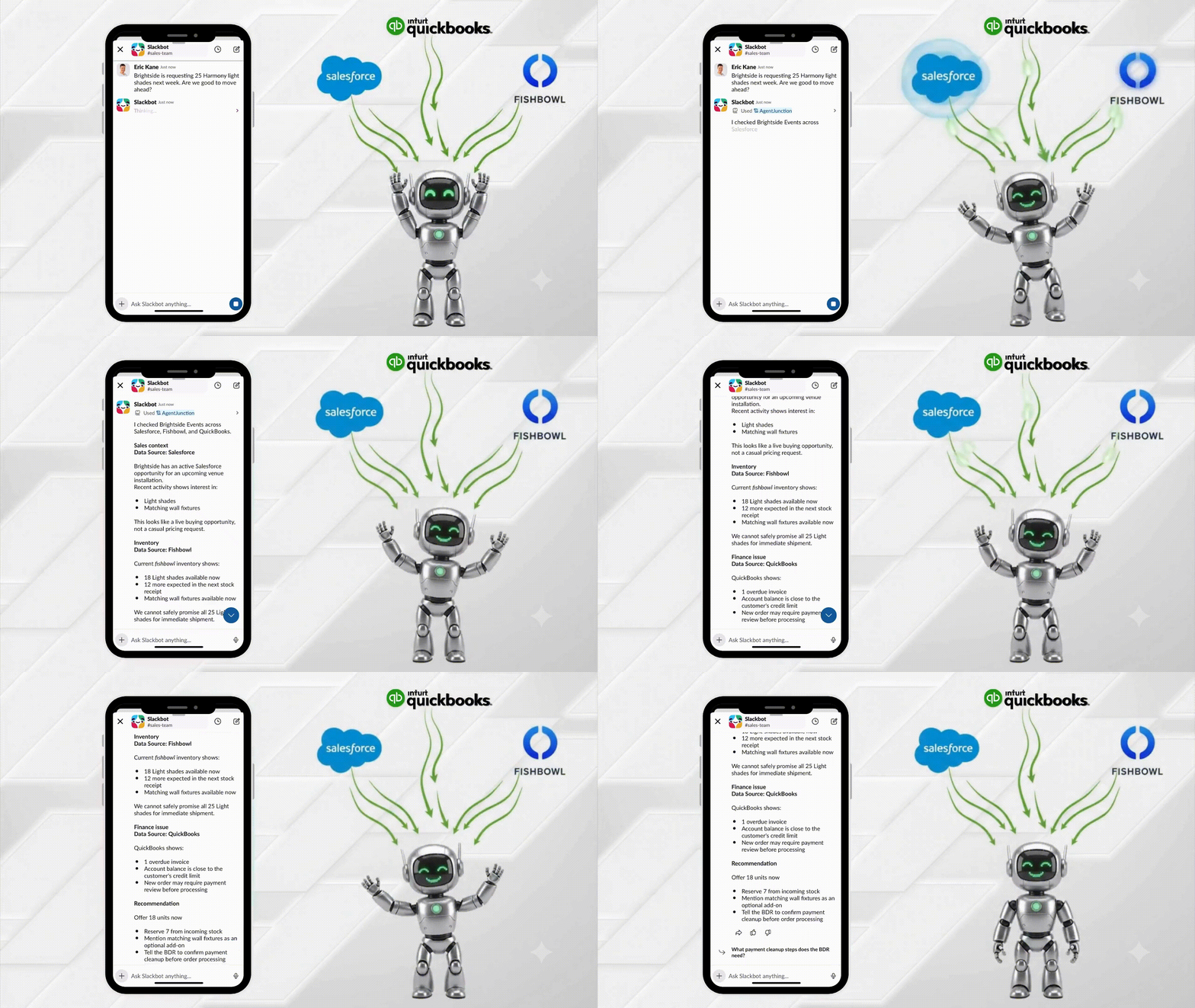
Why it matters: No single system would have given Eric the full picture. Together, they reveal a live buying opportunity – with a finance flag attached.
3. Recommend – from “here’s the data” to “here’s what to do”
This is where Slackbot goes beyond reporting. It recommends a plan: “ship 18 now, reserve the remaining 7 from incoming stock, offer the wall fixtures as an add-on, and ask the customer to clear the open balance before processing”.
When the customer asks for a single shipment instead, Eric simply asks again. Slackbot weighs two options – split now, or hold all 25 – and recommends the faster one based on the event date.
Why it matters: The customer accepts the split shipment on the spot, agrees to clear the invoice today – and asks for pricing on the wall fixtures. The rep just turned a potentially stalled deal into a closed-won upsell!
4. Act – Close the loop without leaving Slack
Since the Slackbot ERP integration through AgentJunction writes to these systems as well as reading them, the follow-through happens in the same thread. For example, the team can prompt Slackbot to:
- Reserve the remaining 7 units against incoming stock in Fishbowl.
- Update the Salesforce opportunity with the split-shipment plan and the add-on interest.
- Create an estimate for the wall fixtures, or check the invoice status, in QuickBooks.
Every action starts with a request from someone in the conversation, so the team stays in the loop – and nobody re-types a thing.
Operational Velocity: Less Hunting, More Selling
- For the field rep: Real answers in front of the customer. No “circling back”, no door left open for a competitor.
- For the account manager: One prompt replaces three logins. No more being the team’s human search engine.
- Nothing to learn: If your team can send a Slack message, they already know how to use it!
The Slackbot ERP Integration Recipe: Slack-First, No Replatforming
No new portal to roll out. No CRM migration. No ETL pipelines to babysit. The setup behind this demo uses:
- Slack and Slackbot, the interface your team already lives in, all day.
- AgentJunction from CloudJunction, for no-code agentic connectivity. Its zero-copy architecture fetches data live, on demand, instead of copying it into yet another database.
- The systems you already run, (Fishbowl and QuickBooks in this demo) with connectivity to Salesforce, SAP, Epicor, Infor, Microsoft Dynamics, FreshBooks, Asana, and more.
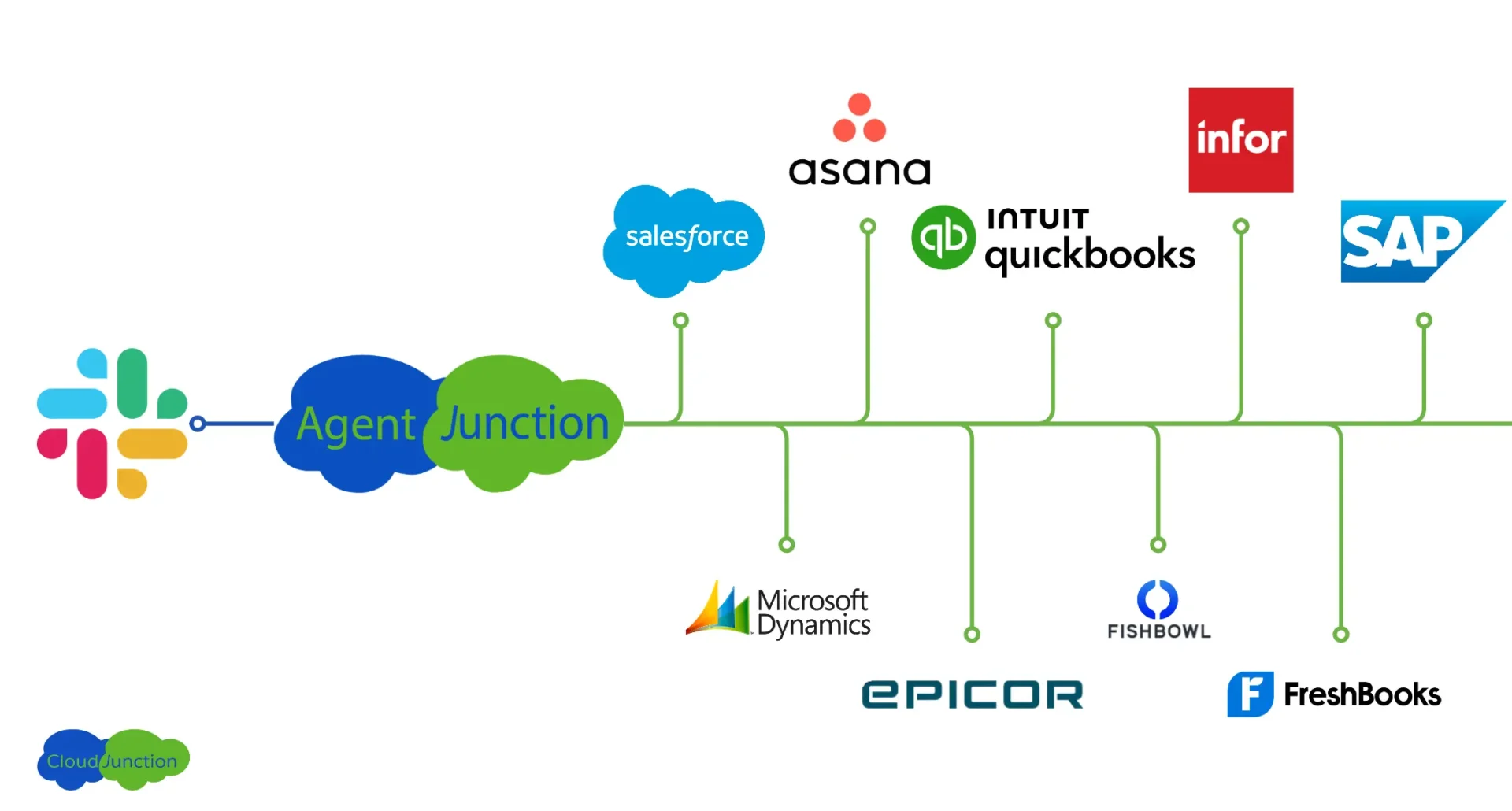
Whether you’re a 20-person distributor running Fishbowl and QuickBooks, or a mid-market manufacturer on Epicor or SAP, AgentJunction works the same way: ask in Slack, get the full picture, act on it.
See it in Action — Watch Demo!
One question. Three systems. A confident answer and a bigger order – in one thread. That’s the difference between accessing business data and putting it to work.
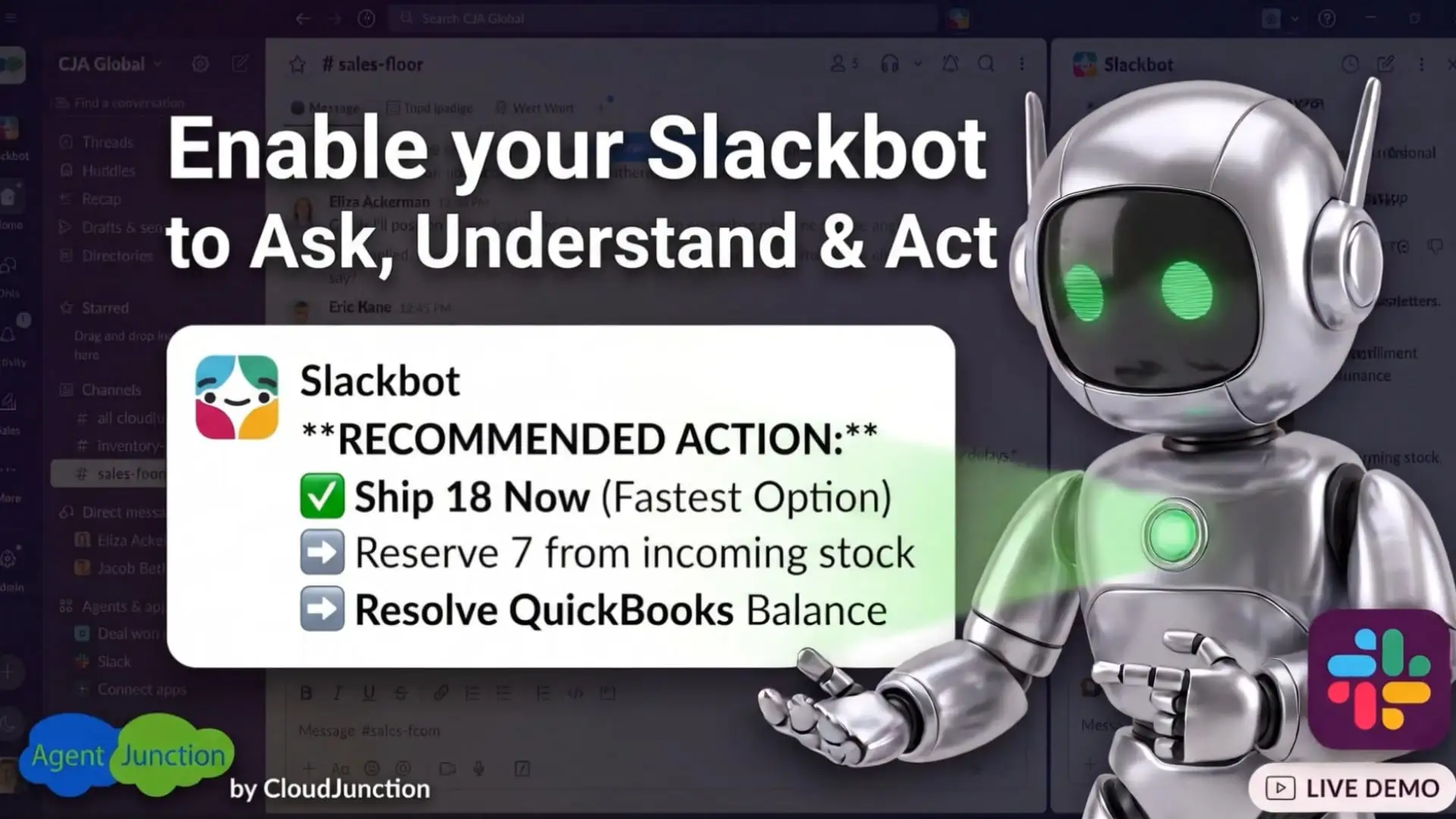
This 75-second demo shows a field rep’s on-site question turning into a confident answer – and an upsell – as Slackbot pulls live data through AgentJunction, inside one Slack conversation.
Try it in your Slack Workspace
Contact CloudJunction or visit agentjunction.io to get a free proof-of-concept of a Slackbot ERP integration – connected to your own ERP, inventory and CRM, right inside your Slack workspace.